
Blog
Housing inventory continues to slide in Miami, Ft. Lauderdale and Palm Beach, awaiting arrival of shadow inventory.
Upon release of the June data, it looks like much of the same in the single-family home and condominium markets in South Florida. Total available inventory continues to slide from a high of over 50,000 available properties in January of 2010, to only 28,335 in June of 2012.

As inventory drops, the simple rules of supply and demand take over. Fewer properties available will obviously mean an uptick in prices. 2012 has shown a gradual uptick in prices, as illustrated in the single-family home price chart below.

The condo market in the tri-county area are showing much of the same.

The price increases are a direct correlation to the continued decrease in available properties for sale on the market. After the robo-signer settlement, you will begin to see more bank-approved short sales, since agreeing to work with troubled borrowers was a major component of the agreement with lenders and loan servicers. Also, you should begin to see a steady dose of the “shadow inventory” as shown in the Bloomberg chart below.
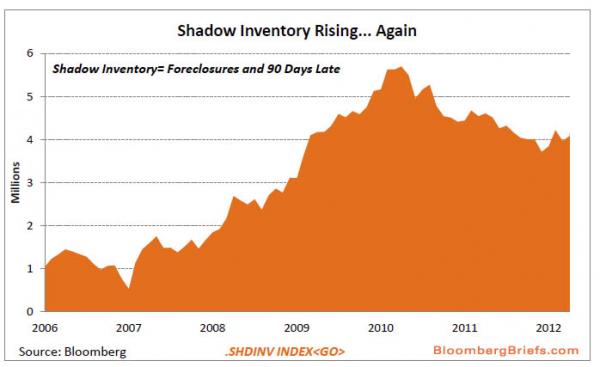
For those of you that are hearing the words “shadow inventory” for the first time, you will start hearing it more frequently over the next year or two. In simple terms, the shadow inventory of properties that you do not currently see on the market. They are homes that are currently in foreclosure or 90-days late on the mortgage payments. After declining for the past two years, it is now on the rise again. Remember that foreclosure activity came to an abrupt halt in late 2010 and is just now getting rolling, much like a locomotive leaving the station. Once the foreclosure machine gets ramped-up again, this number will continue to rise from the roughly 4.2 million homes owned by the banks to a staggering number as high as 6 million, and some wall street analysts have it as high as 8-10 million properties. In short, the analysts shouting that housing has hit bottom are dead wrong. They are ignoring the impact that shadow inventory will have, especially in markets like South Florida. Banks will either agree to short sales or take the properties back in foreclosure and sell them at a discount of about 20% or more. When a property is sold at such a steep discount, it then puts an entire new group of homeowners “underwater” or in a negative equity position on their property. The national figures for underwater mortgages stands at roughly 10 million properties, of which 3 million of those properties are severely underwater (underwater by 25% or more). Eventually these borrowers will either default due to inability to pay, obtain a loan modification, or strategically default on their mortgage because it no longer makes sense to pay it. That property spends some time as part of the shadow inventory and will at some point hit the market as a distressed sale. The process takes time, and in Florida the average foreclosure takes over 800 days to complete. Hopefully this post has helped explain what the South Florida housing market is experiencing, and will continue to experience over the next few years.
The Allied Realty Group residential team serves as the exclusive broker for a variety of financial institutions in the management and sale of distressed single family and multi-family properties. Our team will inspect, repair, market and dispose of REO properties in a manner that mitigates bank losses.
Allied Realty Group’s REO assignment territory is Broward County, Florida and we complete broker price opinions (BPO’s) for banks on a daily basis. All of our residential brokerage clients appreciate our extensive market insight since we are actively visiting properties and preparing comprehensive valuations for asset managers.